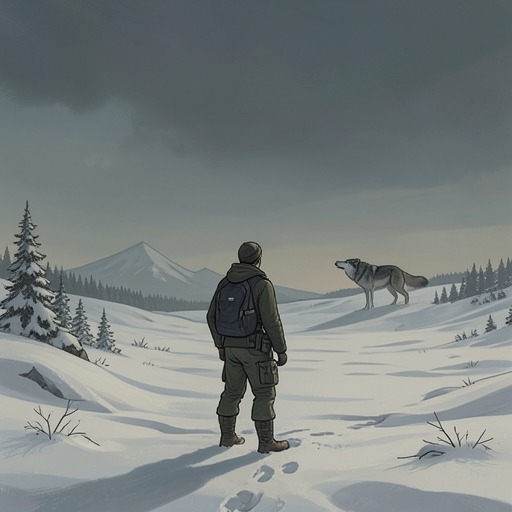
Never Cry Wolf
Never Cry WolfNever Cry Wolf names a book whose subject outgrew its original role: what began as a satire of bureaucracy became an argument for understanding and preserving wolves. The title sits at the intersection of those aims, pointing both to the animal that came to command the narrative and to the fearful stories about wolves that the book challenges. A recollection of the 1946 panic in Churchill gives that challenge a concrete form: an encounter with one sick wolf expanded, in public memory, into an imagined invasion.
From bureaucratic satire to wolf book
Farley Mowat’s preface explains that the book began as a planned satire about the Bureaucrat, whom he described as a peculiar mutation of the human species. The wolf was initially intended as a foil: the main satirical target was a figure insulated by convention, preoccupied with minor facts, and confident in his authority to decide matters for others. The book’s initial design therefore placed the wolf in a supporting role and directed its attention toward bureaucratic habits and claims to expertise.
That design changed as Mowat wrote. He says his interest in bureaucratic buffoonery waned while his attention increasingly turned to the wolf, until the secondary character took over the book. The resulting work became, in the preface’s account, a plea for understanding and preservation. The title consequently marks more than a subject change: it belongs to a book whose argument shifted away from making bureaucracy the principal object of satire and toward defending an animal under sustained human pressure.
The title and the book’s argument
The preface states the book’s central claims directly. Mowat argues that the wolf does not threaten other wildlife and is not a consequential danger or competitor to people. He also says that wolves were being driven toward extinction by human hostility. These claims give the title its argumentative setting: the book asks readers to reconsider the assumptions through which wolves are cast as threats, rather than accept those assumptions as settled truth.
The reception described in the preface shows how contested that appeal was. Mowat reports that authorities did not receive the book kindly and that experts derided it as fiction, even denying that it drew on his two summers and one winter living in the Arctic in close association with wolves. He adds that later official science confirmed almost every aspect of wolf behaviour he had described, while his larger thesis about the wolf’s limited danger to people and wildlife remained largely unaccepted. The title thus fronts a book caught between detailed claims about animal behaviour and continuing resistance to its broader challenge to human attitudes.
Panic, retelling, and the wolf as threat
The preface’s account of Churchill in 1946 gives the title’s anti-panic resonance a specific narrative context. During a rabies outbreak amid scarcity, one sick and dying wolf appeared in Churchill. A Canadian Army corporal said that a gigantic wolf had leaped at him and that he escaped by running to the guardhouse. His report helped send the Army camp into a panic. Canadian and American contingents mobilized, and armed squads searched for what had quickly become, in the alarmed account, several packs of starving wolves.
The consequences of the panic did not match its imagined scale. Eleven Husky dogs, an American private, and a Chippewayan man returning home became casualties of vigilantes, rather than of the wolf. Women and children stayed indoors for two days; soldiers avoided walking between buildings unless they travelled armed by jeep. A wolf reported from an Army aircraft on the second day proved to be a cocker spaniel belonging to the Hudson’s Bay Company manager. On the third day, a truck driver encountered the sick wolf on the road; it was too ill to move and was killed when the truck could not stop in time. The episode places the book’s critique in a pointed contrast: fear produced a sweeping account of danger, while the actual animal was sick and alone.
Mowat emphasizes that the panic continued after it had subsided. Residents of Churchill, and soldiers elsewhere, continued to describe an invasion, recounting desperate encounters and a community under siege. His deliberately exaggerated imagined finale—a flight across frozen plains pursued by wolves—shows how retelling can enlarge a limited event into a legend. In this context, Never Cry Wolf can be read as a warning against allowing fearful repetition to substitute for evidence. That reading follows the preface’s account of the panic and its aftermath; the book does not explicitly explain the title as an allusion to the familiar warning about crying wolf.
A second title and a continuing appeal
When the book appeared in the Soviet Union, its translators struggled with the title and settled on Wolves, Please Don’t Cry. Mowat presents that version as a possible portent: his hope was that people might still prevent another crime against nature, the elimination of a fellow creature with an equal right to life. The alternative title shifts the phrase into a direct appeal, while retaining the wolf at the centre of the book’s moral concern.
The preface sets that concern against evidence of continuing persecution. It notes that several North American wolf races were virtually extinct in 1973 and that a proposed Minnesota plan called for killing two hundred wolves annually. It also records a Quebec contest seeking five thousand dead wolves, with prizes for successful hunters. Against those policies, Mowat points to organizing and resistance: the Ontario Wolf League helped bring about the revocation of Ontario’s provincial bounty, and the Canadian and American Wolf Defenders may have helped persuade Minnesota to abandon its proposed extermination plan. These examples make the title’s plea more than a figure of speech; they connect the book’s changed purpose to the practical question of whether public understanding can restrain the killing of wolves.
The book is listed as Never Cry Wolf (1963, new edition 1973). Its title therefore gathers together a change in literary purpose, a challenge to the wolf’s reputation, and an appeal for its survival. The preface ends not with confidence that the argument has prevailed, but with the possibility that there is still time to prevent further loss.